Pressing triggers explained: the cues that tell a team when to jump
A press only works when everyone goes at once. These are the cues that tell a team when to jump, and how the first presser, second presser and cover should move.
By Callum Rees 9 min read
Key facts
- Topic
- Pressing
- Written by
- Callum Rees
- Published
- Reading time
- 9 minutes
In short
- A pressing trigger is a shared cue that tells the whole team to press at the same moment.
- Five triggers to teach first: a backward pass, a heavy touch, a receiver facing their own goal, a pass to the touchline and a slow or bouncing ball.
- The first presser curves their run to cut off a pass; the second presser takes away the most likely escape pass.
- A cover player stays behind the ball, so one clever touch does not beat the whole press.
Most pressing goes wrong in the first second. One player charges, the other ten watch, and the ball has gone before anyone else has moved. In this guide I explain the cues that tell a team when to press, and how the nearest players should move once someone decides to go.
What a pressing trigger actually is
A pressing trigger is a moment in the game that everyone on your team has agreed means “now”. It might be a pass, a touch or the way an opponent is standing. The cue itself matters less than the fact that all eleven players recognise it at the same time.
Without a shared trigger, pressing becomes a matter of personality. The keenest player sprints, the cautious one holds back, and a gap opens between them. I saw this every week when I coached youth teams in Cardiff: the effort was there, but it arrived at different moments.
A trigger turns pressing from a feeling into a plan. When the cue appears, the nearest player goes, and the players behind them already know their jobs. When it does not appear, the team stays compact and waits.
Waiting is not laziness. It is saving energy for a moment that gives you a real chance of winning the ball.
This guide explains general principles rather than one particular match. The ideas come from my own sessions and from watching a lot of football, and I have labelled my opinions where they appear.
The five triggers I teach first
There are many possible cues, and every coach has a favourite list. These are the five I keep coming back to, because players of almost any age can learn to spot them.
1. The backward pass
When the opposition passes backwards, two things happen. The ball travels away from your goal, and your players are suddenly facing the way they want to run. The player receiving it often has fewer options, because their teammates ahead of them are now on the wrong side of the ball.
A backward pass also buys you time. The ball is travelling for a second or two, and in that time your players can close a lot of space. The press should start as the pass is played, not when it arrives.
2. The heavy or bad touch
A loose touch is the most obvious trigger, and the one players react to most naturally. If the ball bounces away from the receiver, they have to look down and chase it. For that moment they cannot look up and pick a pass.
The key is reacting to the touch, not the reception. I tell players to watch the ball arrive at the opponent’s feet. If it sticks, they hold their position. If it squirms away, they go.
3. A receiver facing their own goal
When a player receives with their back to the direction they are attacking, they cannot see what is in front of them. They have to turn, lay the ball off or shield it. Each of those takes time, and pressing them from behind takes the turn away altogether.
Young players find this the hardest trigger to read, because it asks them to notice body shape rather than the ball. It is worth the effort. A player facing their own goal is often the easiest player on the pitch to press.
4. A pass to the touchline
The touchline is the only defender that never gets tired. When the ball goes wide, the receiver has lost half their options, because there is nothing on the other side of the line. If you close the pass inside and the nearest pass forward, they are trapped.
5. A slow or bouncing pass
A pass that is underhit, or one that bobbles on a bumpy surface, gives your players extra time to arrive. On grassroots pitches this happens constantly. A bouncing ball is also hard to control first time, so it often leads straight into trigger number two.
Opinion: If I could teach only one trigger to a new team, it would be the pass to the touchline. It is easy to see, it happens in every match, and it gives players a natural boundary to press against. The others matter, but this one builds confidence quickly.
How the trap works on the touchline
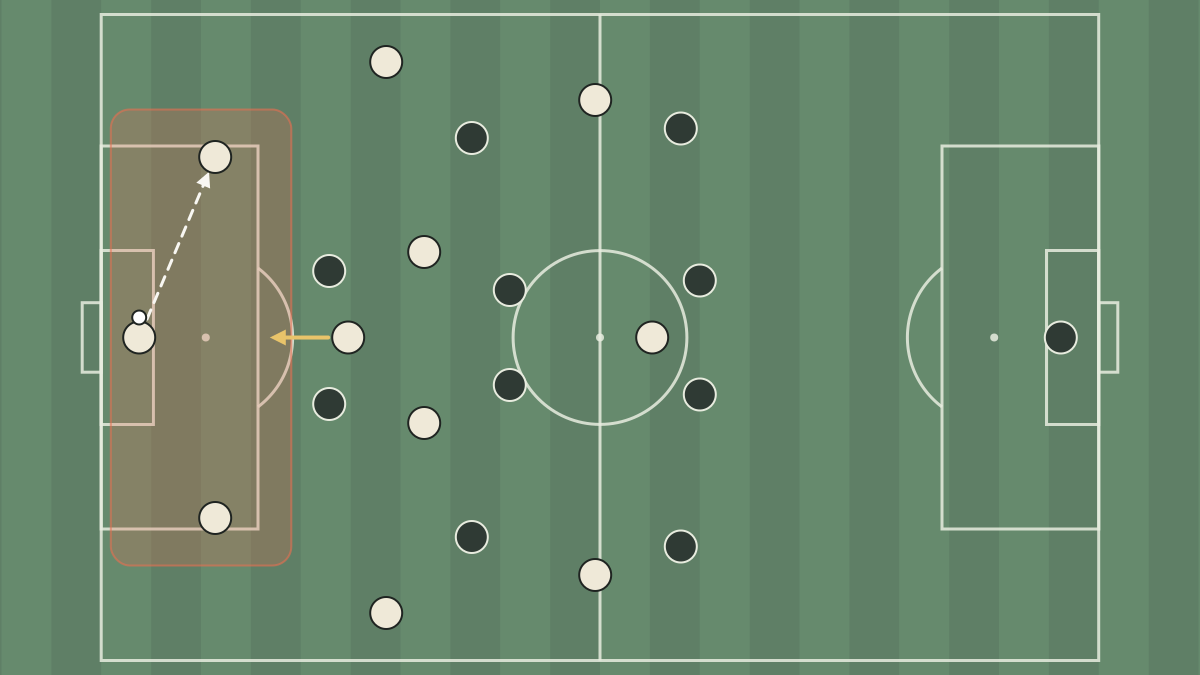
The touchline trigger is easiest to understand with a picture, so Figure 1 shows a typical example near the light team’s own goal.
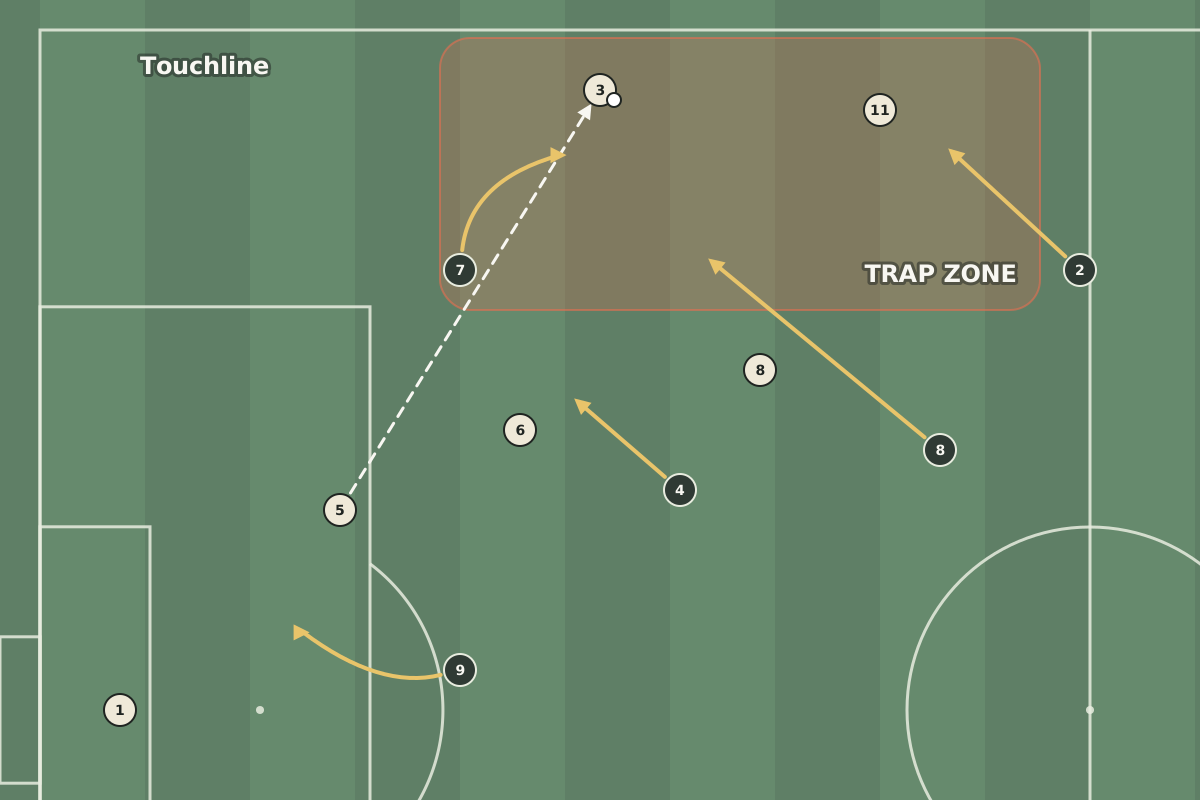
Figure 1: The light centre-back (5) passes to the full-back (3). The dark winger (7) curves their run to block the pass back inside, while their teammates close the nearest options and trap the ball in the shaded zone.
In Figure 1, the pass from the centre-back to the full-back is the trigger. As soon as the ball leaves the centre-back’s foot, the dark winger (7) starts their run. Notice that they do not run straight at the full-back. They curve the run from the inside, so their body blocks the pass back to the centre-back.
That curved run is the most important detail of the whole press. A straight run invites the full-back to play the ball back inside and start again. A curved run leaves the full-back only one way to go, which is down the line towards the shaded trap zone.
The other dark players move at the same moment. The central midfielder (4) steps up towards the light holding midfielder (6), so the pass inside is covered. The second dark midfielder (8) runs into the lane between the full-back and the light midfielder (8), taking away the diagonal pass.
Further up, the dark full-back (2) gets tight to the light winger (11), on the side nearer their own goal. That means a pass down the line has to beat a defender who is already there.
The dark striker (9) has a quieter job. He slides across to sit between the centre-back and the goalkeeper. If the full-back somehow finds a pass backwards, the next player in the chain is already under pressure.
When all of this happens together, the full-back has the ball, the touchline on one side and dark shirts on every other side. That is the moment you want. He can try to dribble, kick it out or force a pass into a crowded area. In my experience of youth football, the ball comes back to the pressing team far more often than not.
The three roles: first presser, second presser and cover
Triggers tell you when to go. Roles tell you who goes and what they do. I split every press into three jobs, and I make sure every player can name them.
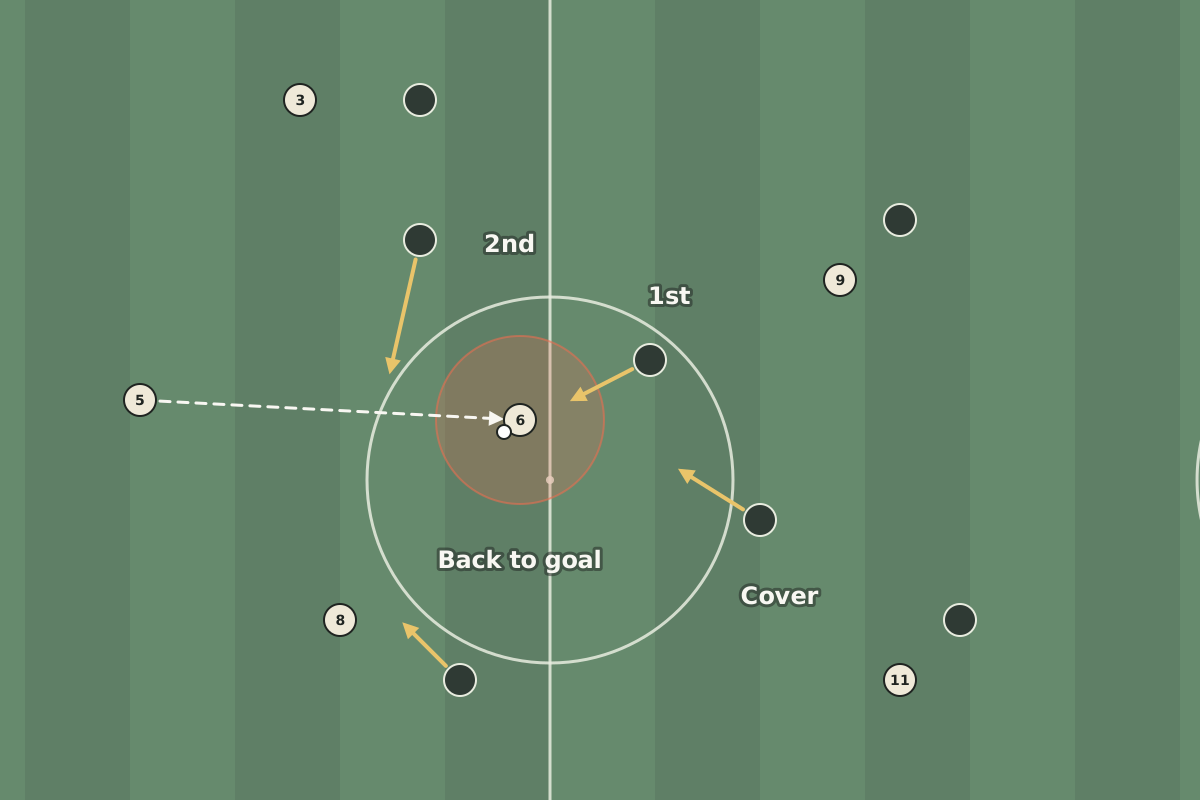
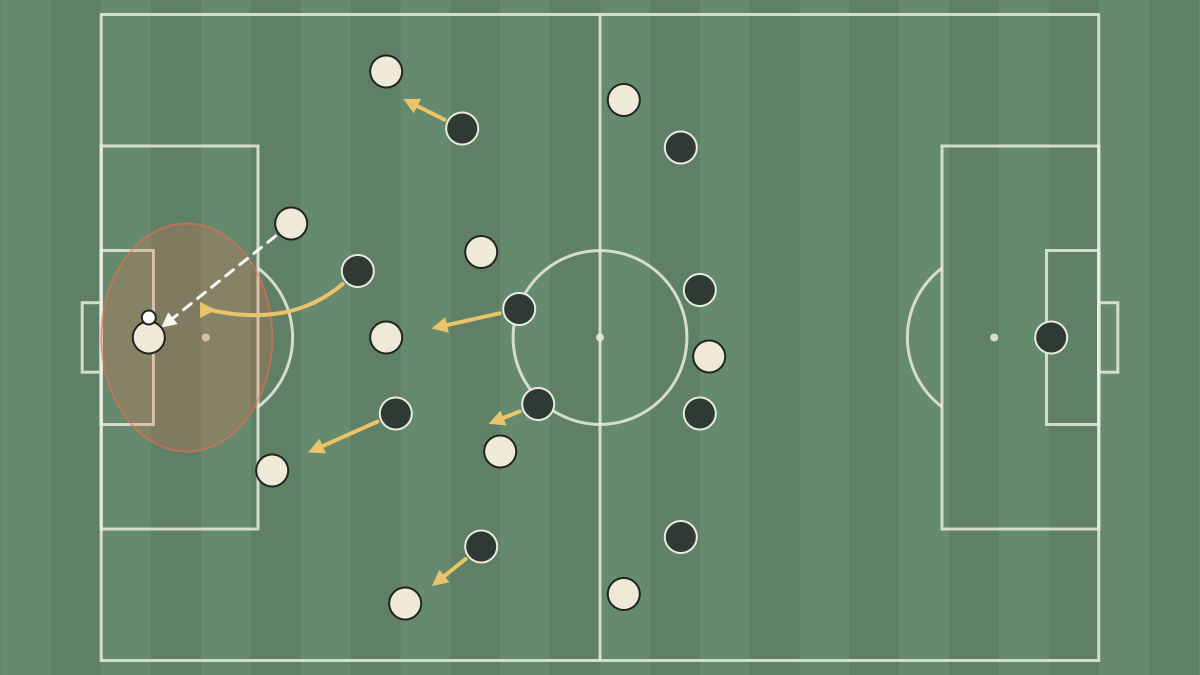
Figure 2: The light midfielder (6) receives facing their own goal. The first presser closes from behind, the second presser blocks the pass back to the centre-back, and the cover player stays behind the ball.
Figure 2 shows the three roles around a different trigger: a midfielder receiving with their back to the way they are attacking. The light centre-back (5) has played the ball into them in the centre circle, and the dark team reacts.
The first presser
The first presser is the player nearest the ball when the trigger happens. In Figure 2, that is the dark player marked “1st”, who closes the receiver from behind. His main job is not always to win the ball. It is to stop the receiver turning and to make the next pass predictable.
I tell first pressers to slow down slightly for the last two or three steps. Arriving at full speed makes it easy for an opponent to roll you or slip past. Arriving under control lets you stay on your feet and react to what they do.
The second presser
The second presser reads where the ball will go next and gets there first. In Figure 2, the player marked “2nd” drops into the passing lane back to the centre-back. If the receiver tries the simple lay-off, the second presser is waiting to intercept it.
This role needs the most thinking. The second presser has to guess the most likely escape pass and take it away, rather than following the ball. When young players get this right, the press suddenly looks organised, because the first and second pressers are working as a pair.
The cover
The cover player stays behind the ball. In Figure 2, the player marked “Cover” shuffles across rather than charging in. If the receiver manages to spin away from the first presser, the cover is there to slow them down while the others recover.
The cover is the safety net. Without one, a single clever touch beats the whole press and leaves your back line exposed. I would rather a team presses with three players and keeps one in cover than throws four players at the ball with nobody behind.
What happens to everyone else
The players away from the ball still have a job. In Figure 2, the dark player at the bottom of the diagram moves towards the light midfielder (8), so the sideways pass is not free either. The whole team shifts towards the ball, and the distances between players stay roughly the same.
This is also where a press most often breaks down. If the back line does not step up with the forwards, a big space opens between them. One pass into that space beats everyone who has pressed. When I review my own sessions, that gap is usually the first thing I check.
When not to press
Knowing when to stay still is just as important as knowing when to go. If an opponent receives facing forward, with a good first touch and a clear pass ahead of them, pressing usually just pulls a player out of position.
In those moments, the team should drop back into a compact shape and wait for the next trigger. It might come two passes later. Patience here is a skill, not a weakness.
Opinion: I think many grassroots teams press too often rather than too little. Players hear that pressing is modern and exciting, so they chase every ball. Teaching them to wait for a trigger has, in my sessions, made them win the ball more often, not less.
How I coach triggers in training
I start by naming the triggers out loud. In a small game, I freeze play when a trigger appears and ask the players what they saw. After a few sessions they start shouting the trigger themselves, which is the best sign that the idea is sinking in.
Next, I use small-sided games with a reward for winning the ball quickly after a trigger. A goal scored within a few seconds of winning possession might count double. This gives players a reason to press together rather than one at a time.
Finally, I let the players lead. The best pressing teams I coached were the ones where an experienced player called the trigger and everyone else responded. The coach can set up the idea, but on a Saturday morning it has to belong to the players.
The short version
Pressing works when everyone goes at the same moment for the same reason. Triggers give you that reason, and the touchline is the easiest one to start with. Roles make sure the first presser, second presser and cover each know their job. Get those two things right, and even a young team can make the opposition feel crowded.
Every tactical claim on Pressing Matters is backed by match footage or published data, cited with the match and date. Opinion is labelled as opinion. Spotted a mistake? Tell us and we will correct it at the end of the article.
Written by
Callum Rees
A former youth-team coach from Cardiff with a UEFA B licence, Callum spent eight years running sessions before he started writing about them.
More from Callum Rees