The back three explained: 3-4-3, 3-5-2 and the wing-backs that make it work
How a back three really works: what wing-backs do, how 3-4-3 and 3-5-2 change shape with and without the ball, and why it can suit Sunday-league sides, or not.
By Ade Okafor 7 min read
Key facts
- Topic
- Formations
- Written by
- Ade Okafor
- Published
- Reading time
- 7 minutes
In short
- A back three uses three centre-backs, with wing-backs providing all of the team's width.
- In possession it often looks like a 3-4-3 or 3-5-2; out of possession the wing-backs drop to make a back five.
- Its main weakness is the space beside the wide centre-backs when a wing-back is caught upfield.
- It asks a lot of two players' lungs, so fitness and numbers in the squad matter as much as tactics.
Every few seasons a back three comes back into fashion, and every few seasons someone on my Sunday-league side asks if we should try it. The honest answer is that it depends on your players more than on the formation. In this guide I will explain how a back three works, what the wing-backs do, and where it can come unstuck.
What a back three actually is
A back three simply means a team plays with three centre-backs instead of two. That sounds like a small change, but it alters the whole shape of the side. With three players in the middle of defence, the full-backs are freed to become something else: wing-backs.
The numbers you see written down, 3-4-3, 3-5-2 or 5-3-2, are all versions of the same idea. The first number counts the back three, and the rest describes how the other seven are spread out. The important thing to remember is that the shape changes depending on whether the team has the ball.
That is why I am wary of arguing over the name. A team listed as a 3-5-2 on the teamsheet might look like a 3-4-3 when it attacks and a 5-3-2 when it defends. Same players, same system, different moments.
The three centre-backs
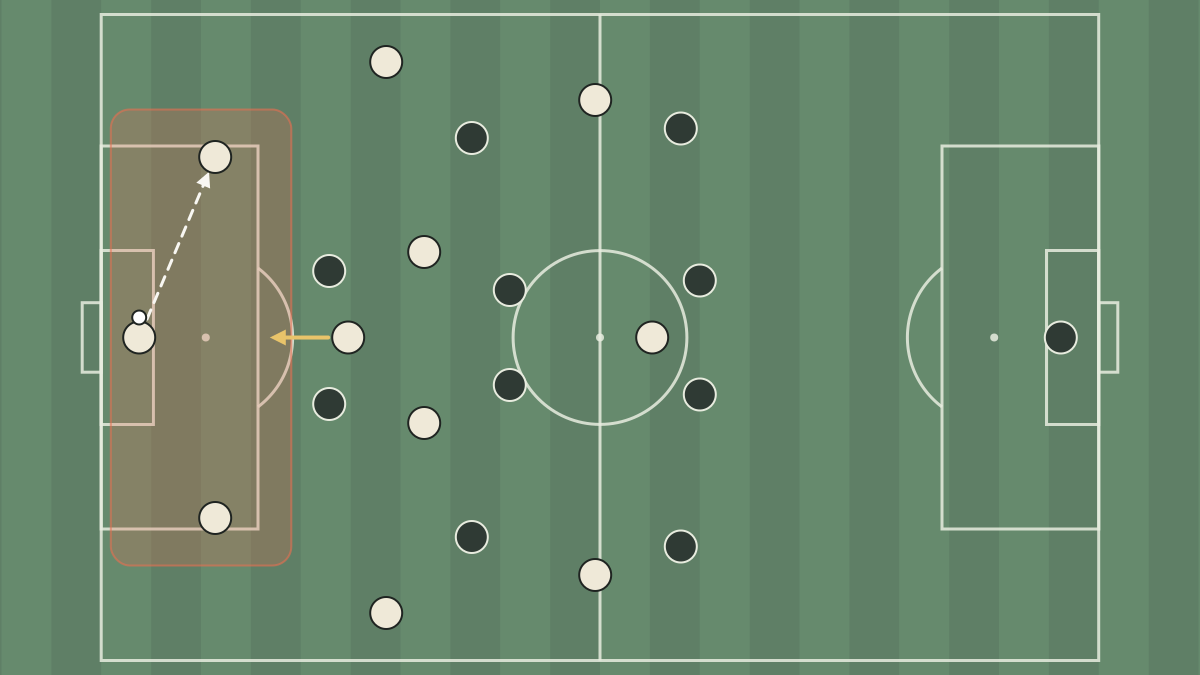
The middle of the three is usually the organiser. They stay central, cover the space behind the other two, and often do much of the talking. In the build-up they are the one most likely to receive the ball from the goalkeeper.
The two outer players are known as the wide centre-backs. Their role is the interesting one. Without the ball, they defend like centre-backs. With it, they are allowed to step out, carry the ball forward into the channels and even join attacks, because there are still two players behind them.
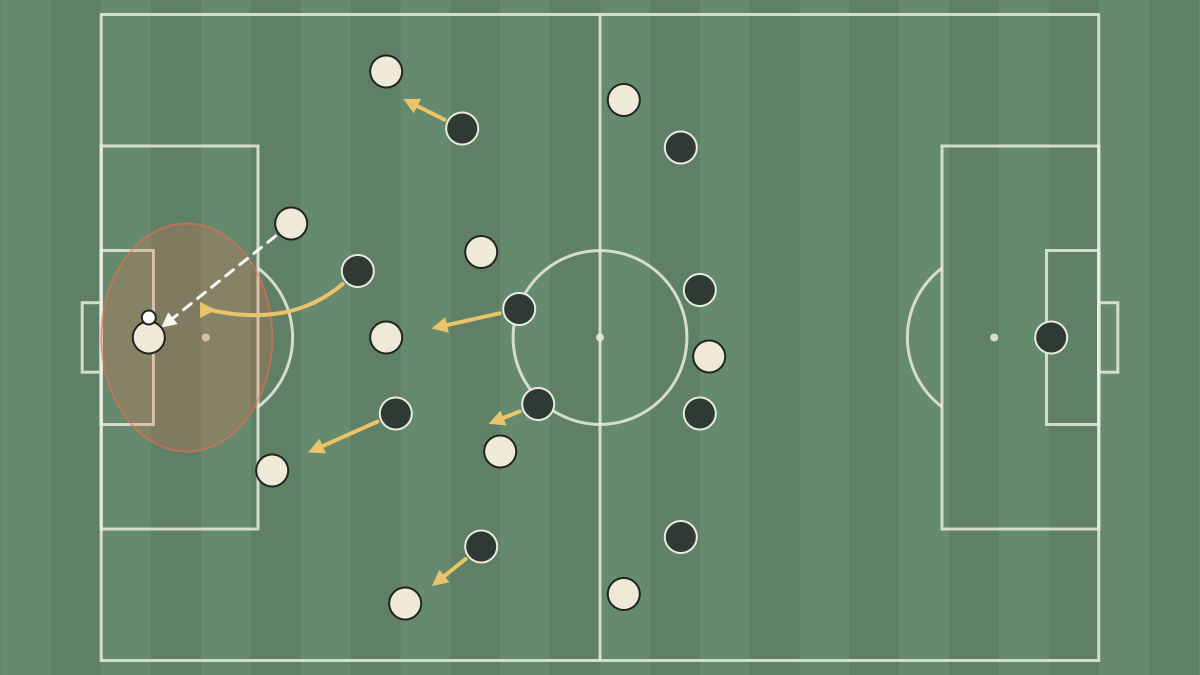
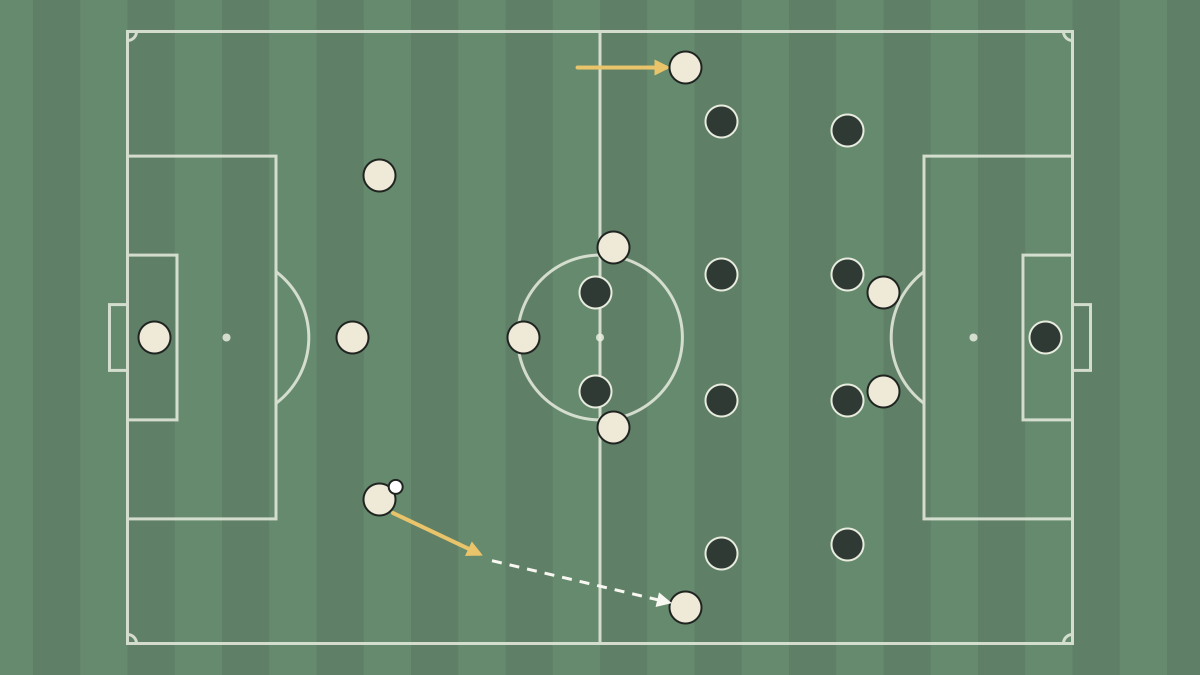
In Figure 1, you can see this happening. The light team is attacking from left to right. Their wide centre-back, number 6, has the ball and is carrying it forward into the space outside the opposition’s two strikers, before passing out to the wing-back.
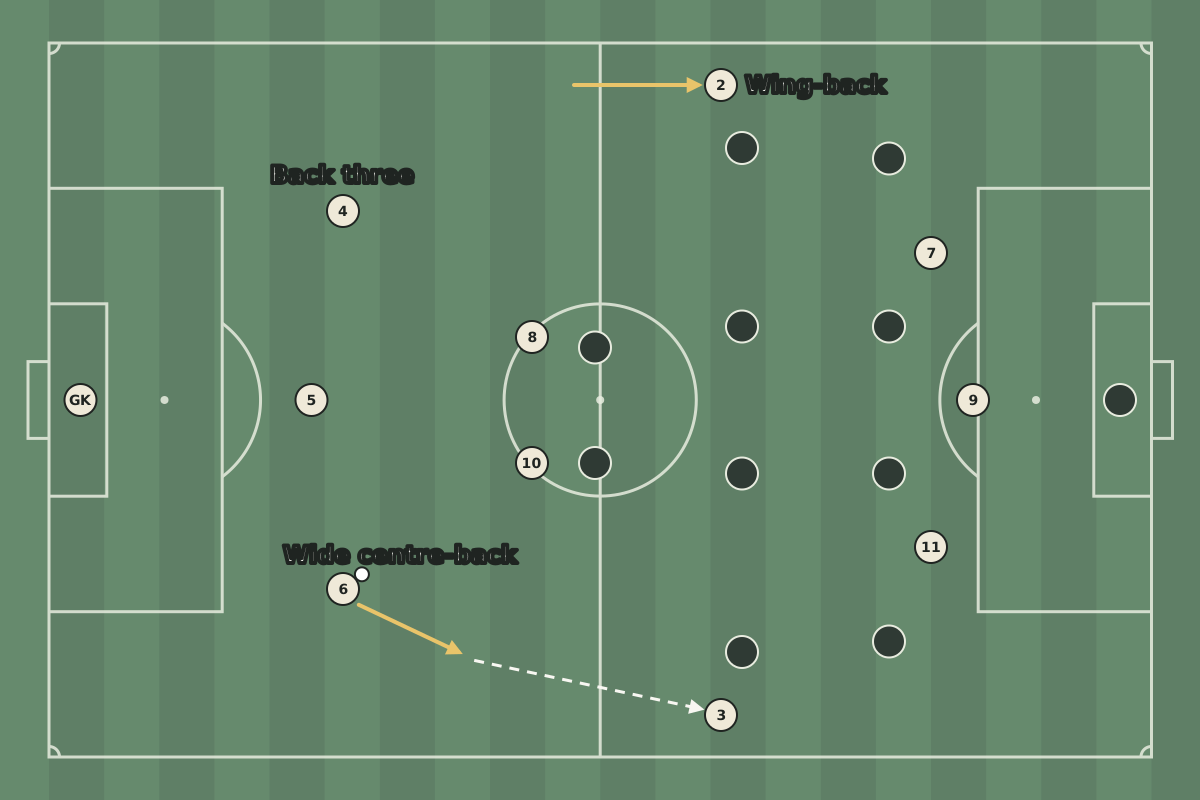
Figure 1: A 3-4-3 in possession. Numbers 4, 5 and 6 form the back three, wing-backs 2 and 3 hold the touchlines, and the wide centre-back carries the ball before passing to the wing-back.
Against a team playing two strikers, as the dark side in Figure 1 does, the back three has a built-in advantage. There are three defenders against two forwards, so one of them is always free. That spare player is often the one who starts attacks.
What wing-backs do
The wing-backs are the heart of the system. In a back four, you usually have a full-back and a winger on each side. In a back three, one player on each side does both jobs.
In possession, the wing-back’s main job is width. Look again at Figure 1. Numbers 2 and 3 are right on the touchlines, level with the opposition midfield. That stretches the defence across the pitch and opens gaps for the front three to run into.
Out of possession, they have to get back. When the ball is lost, the wing-backs drop alongside the three centre-backs to make a back five. That is where the 5-3-2 or 5-4-1 label comes from.
This means a wing-back might sprint the length of the pitch several times in a half. It is one of the most demanding roles in football, and it is the first thing I think about when someone suggests trying a back three.
How the shape changes in and out of possession
With the ball
When a back-three team has the ball, they usually try to create overloads in midfield and out wide. With the wing-backs pushed high, the front of the team often has five players across the pitch: two wing-backs plus three forwards in a 3-4-3, or two wing-backs plus two strikers and an attacking midfielder in a 3-5-2.
That is a lot of attackers for a back four to deal with. Each defender has someone to watch, and nobody is spare to cover.
Without the ball
Without the ball, the shape becomes much more cautious. The wing-backs drop in, and the team defends with five across the back and three or four in front. That is a very hard shape to play through, because the five defenders cover the whole width of the pitch.
The trade-off is that there are fewer players higher up. In a 5-3-2, only two forwards are left to press or hold the ball up. If those two cannot keep possession, the team can find itself defending for long spells.
Why it can suit Sunday-league and lower-league sides
At my level, there are a few good reasons to try a back three.
The first is that it suits squads with plenty of centre-backs. Most Sunday sides I have seen have more players who are comfortable defending in the middle than natural wingers or full-backs. A back three gives three of them a place in the team.
The second is cover. In my experience, a lot of the goals conceded on a Sunday come from simple balls in behind, where one centre-back is caught out. With three centre-backs, there is nearly always a second defender ready to cover.
The third is width without wingers. If you have two fit, willing players who enjoy running up and down the line, a back three lets them be your width. That can be easier to find than two tricky wingers and two attacking full-backs.
In the women’s and non-league football I watch, the back three is a fairly common sight, and I think part of the reason is the same. It gives a solid base to sides who may not have the time on the training ground to drill a complicated pressing game.
Opinion: For a Sunday side with good centre-backs and two athletes on the flanks, I think a back three is often a better fit than a back four. It plays to what most squads at our level actually have.
The weaknesses
No system is free, and the back three has two well-known problems.
The space beside the wide centre-backs
The first is the channel beside each wide centre-back. When the wing-back on that side is high up the pitch, there is a large gap between the wide centre-back and the touchline. If the ball is lost, the opposition can play straight into that gap.
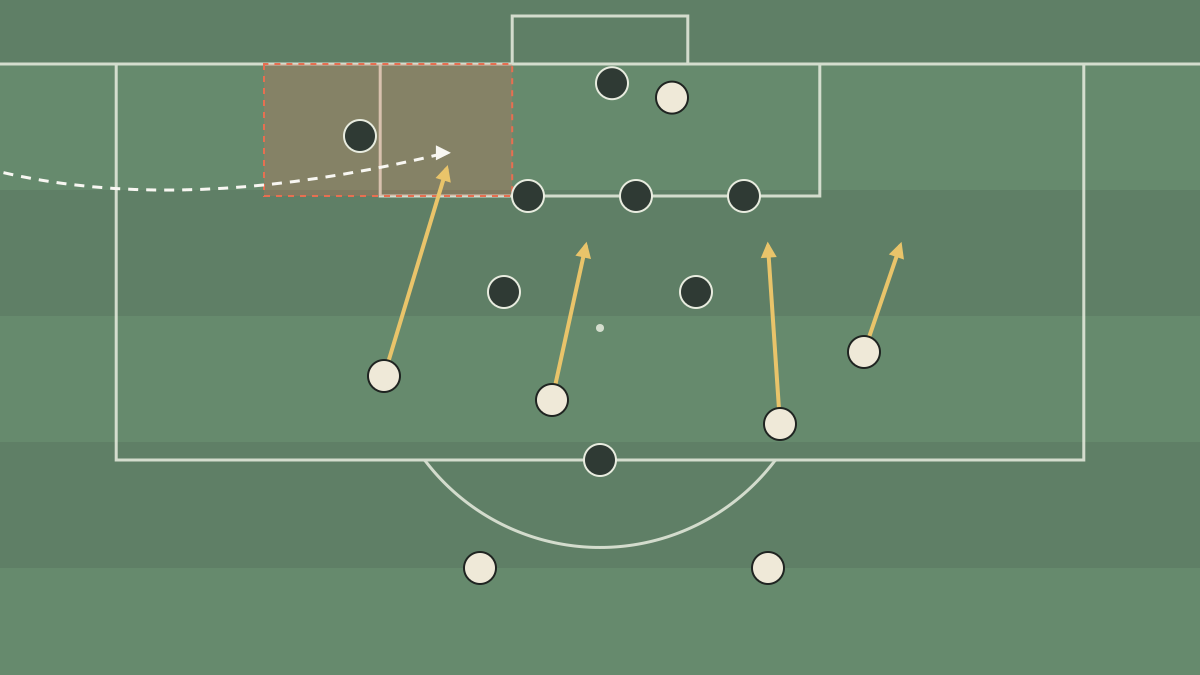
Figure 2 shows exactly this. This time the dark team is the one playing a back three. Their right wing-back, number 3, has been caught high after an attack and is sprinting back. The opposition winger is already running into the shaded area beside the wide centre-back, number 6, and the pass is on its way.
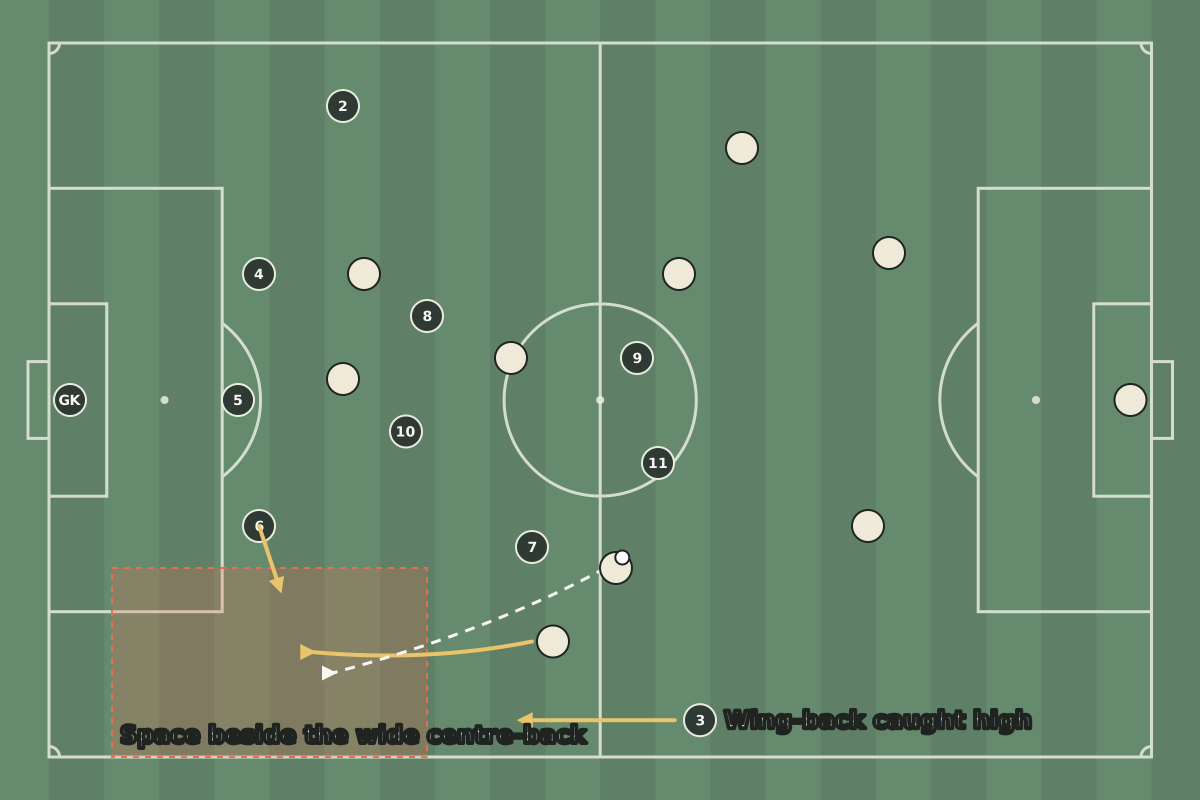
Figure 2: The weakness. The dark team’s wing-back is caught upfield, and the shaded channel beside wide centre-back 6 is open for the light team’s winger to run into.
The wide centre-back now has a choice. If they step across to cover, they leave a gap in the middle. If they stay, the winger has a free run at the box. Neither option is good, and it is why teams who play this way need their midfielders to tuck in and help quickly.
Tired wing-backs
The second weakness is fitness. As I mentioned, the wing-back role is exhausting. In the last twenty minutes of a match, a tired wing-back is slower to recover, and the gap shown in Figure 2 appears more often.
At professional level, teams can rotate players or make substitutions to deal with this. At Sunday-league level, you may only have one or two subs, and they may not be the right players. If one wing-back is struggling, the whole system can wobble.
Opinion: This is the main reason I would not play a back three every week with my own side. If your two wing-backs are not among your fittest players, the system will cost you more than it gives you.
Other things that can go wrong
A back three can also struggle against a team that plays with one striker and two wide forwards. Suddenly the three centre-backs are only marking one player in the middle, and the wide forwards are attacking the spaces either side. Unless the wing-backs drop deep, the team can be outnumbered on the flanks.
The other risk is a lack of numbers in central midfield. In a 3-4-3, there are only two central midfielders. Against a team with three in midfield, those two can be overrun, and the wide centre-backs may need to step up to help.
Should you try it?
My honest advice is to look at your squad before you look at the formation. Ask yourself three questions. Do you have three centre-backs who can all defend? Do you have two players who can run up and down the touchline for ninety minutes? And do your midfielders understand that they will need to cover the channels when the wing-backs are caught upfield?
If the answer to all three is yes, a back three is well worth trying. If not, a back four with a clear plan will usually serve you better. As with most things in football, the shape matters less than whether your players understand it and can keep it going for the full match.
Every tactical claim on Pressing Matters is backed by match footage or published data, cited with the match and date. Opinion is labelled as opinion. Spotted a mistake? Tell us and we will correct it at the end of the article.
Written by
Ade Okafor
Ade manages a Sunday-league side in south London and watches more Women's Super League and National League football than is healthy.
More from Ade Okafor