Building out from the back: why teams play short, and when to go long
Why so many teams now play short from the goalkeeper, the shapes they use to do it, and how to tell when a long ball is the smarter choice against a high press.
By Callum Rees 8 min read
Key facts
- Topic
- Build-up play
- Written by
- Callum Rees
- Published
- Reading time
- 8 minutes
In short
- Playing out from the back aims to start attacks with control, rather than a contested header in midfield.
- The usual shape: centre-backs split wide, a midfielder drops between them and the goalkeeper acts as an extra player.
- Since the 2019 Laws of the Game update, players can receive a goal kick inside their own penalty area.
- Against a man-for-man press, a planned long ball into a supported area can be the smartest pass.
A short goal kick to a centre-back standing at the edge of the box makes plenty of supporters nervous. To me it is one of the most revealing moments in a match, because it shows how a team wants to attack. In this guide I explain why teams build out from the back, the shapes they use, and when kicking it long is the better decision.
Why bother playing short?
The simple answer is control. A long goal kick often becomes a contest: a header in midfield, then a scramble for the second ball. A short pass keeps the ball with your team and lets you choose where the attack goes.
There is a second reason that is easy to miss. When you play short, the opponent has to come forward to press you. Every player who steps up leaves space behind them. Building from the back is partly about pulling the opposition out of shape, so there is room further up the pitch.
The Laws of the Game changed to help as well. Since the 2019 update, players can receive a goal kick inside their own penalty area. Before that, everyone had to wait outside the box until the ball left it, which made short goal kicks much riskier.
This guide covers general principles rather than one particular match. The ideas come from my years running sessions and watching a lot of football, and I have labelled my opinions where they appear.
The basic shape: wide centre-backs and a dropping midfielder
Most teams that build from the back use a version of the same idea. They try to have more players near their own goal than the opposition has in its first line of pressure.
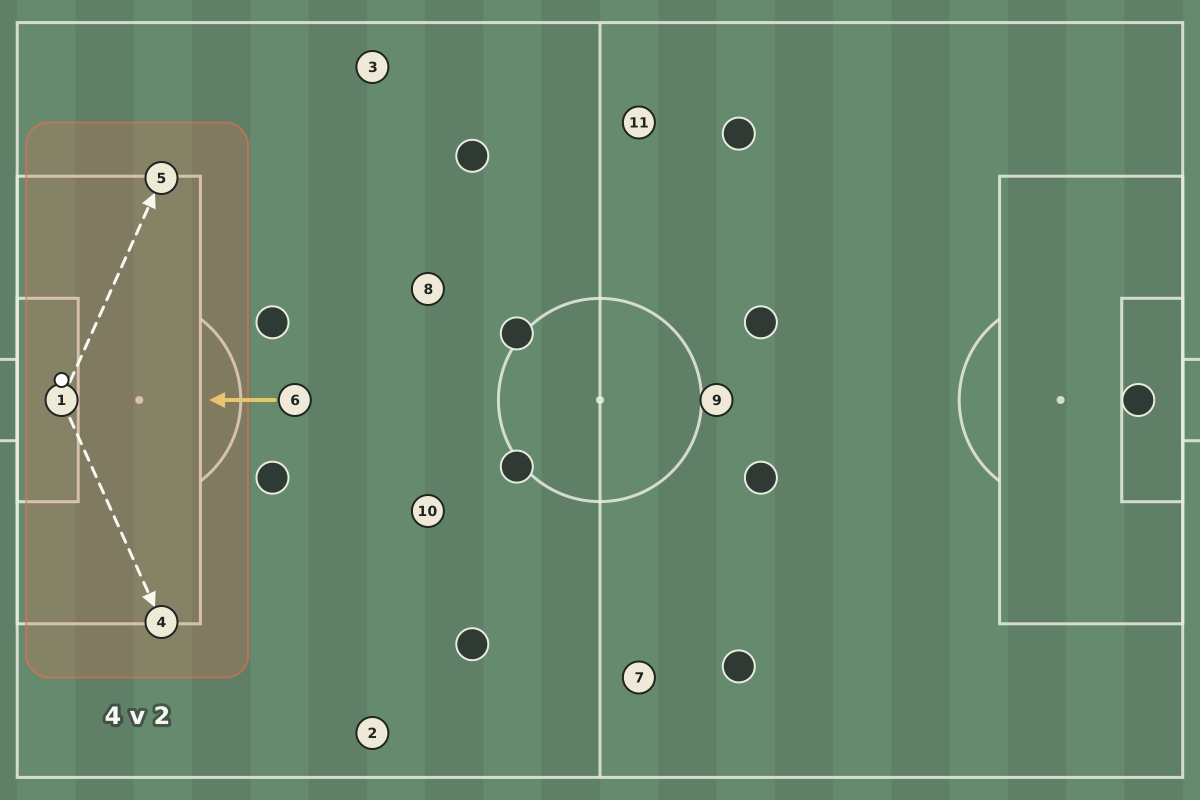
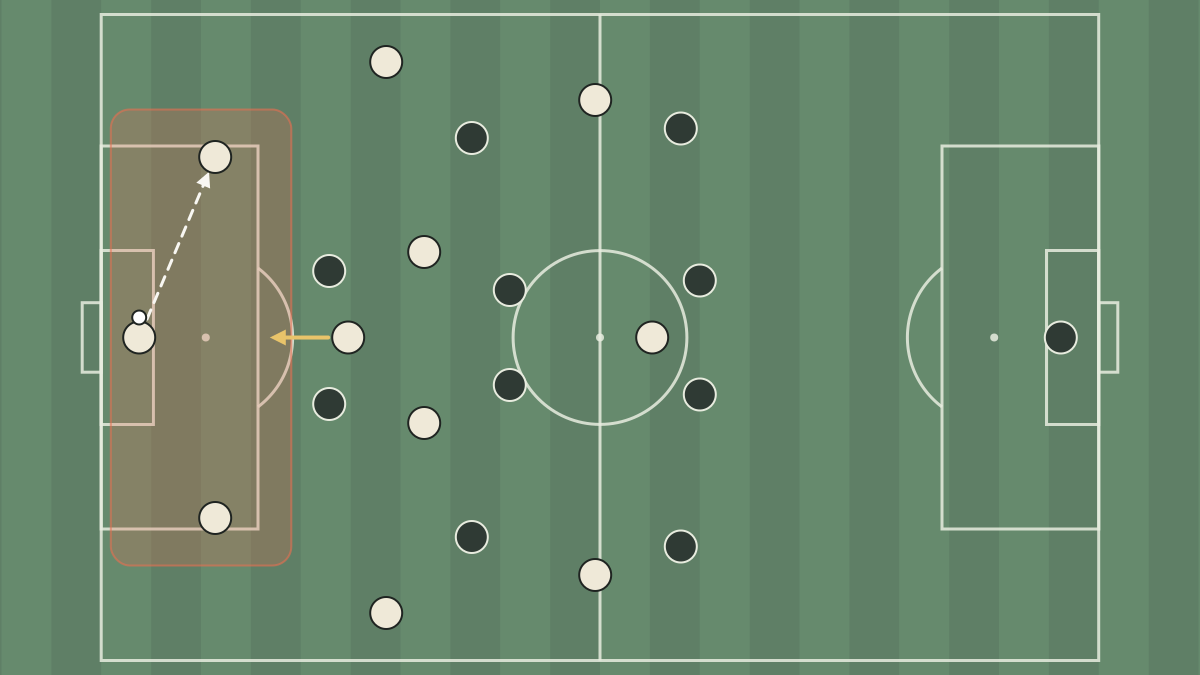
Figure 1: The light centre-backs (5 and 4) split towards the corners of the penalty area, and the holding midfielder (6) drops between them. With the goalkeeper (1), that makes four players against two strikers in the shaded zone.
In Figure 1, the two centre-backs have moved wide, close to the corners of the penalty area. This stretches the opposition’s front two, because they cannot cover both centre-backs and the middle at the same time.
The holding midfielder (6) drops into the space between the centre-backs. You can see the run marked by the yellow arrow. The 6 gives the goalkeeper a third short option, straight through the middle, and gives the centre-backs a nearby player to pass to if they are pressed.
Count the players in the shaded zone in Figure 1. The light team has the goalkeeper, two centre-backs and the midfielder. The dark team has two strikers. That four against two is the whole point of the shape. If the ball moves quickly enough, one light player should always be free.
The full-backs go high and wide
Look at the full-backs (3 and 2) in Figure 1. They are not standing next to the centre-backs. They have pushed up the pitch, close to the touchlines. This pulls the opposing wide players back with them and opens up space for the centre-backs to carry the ball forward.
The goalkeeper as the extra player
The goalkeeper is the reason the numbers work. In the shaded zone the keeper counts as an outfield player, as long as they are comfortable passing with both feet. A keeper who can receive under pressure and pick a pass is worth a whole extra player in build-up.
This is why the way goalkeepers are coached has changed so much. When I was running youth sessions, my keepers joined the passing drills as often as the outfield players did. If your keeper cannot pass, building from the back becomes very difficult.
Other common shapes
The shape in Figure 1 is the most common, but there are variations worth knowing.
Some teams play with three centre-backs and let the wing-backs push high. With three players across the back, the first line already outnumbers a front two without anyone needing to drop.
Other teams ask a full-back to tuck inside next to the holding midfielder. This creates an extra passing option in the centre of midfield rather than in the first line. It is a more complicated idea, and I would not start with it at youth level.
Whichever shape you use, the principle is the same. Find a numbers advantage near your own goal, then move the ball quickly enough to use it.
What the opposition does: the high press
Building out from the back invites pressure. A good opponent will not stand off and let you pass sideways. They will press, and the way they press decides what you should do next.
If the opponent presses with only two or three players, the shape in Figure 1 usually works. You have more players than they do, and patient passing will find the free one.
The problem comes when the opponent goes man-for-man. Each of your players near goal has a direct opponent standing next to them, and there is no spare player to pass to.
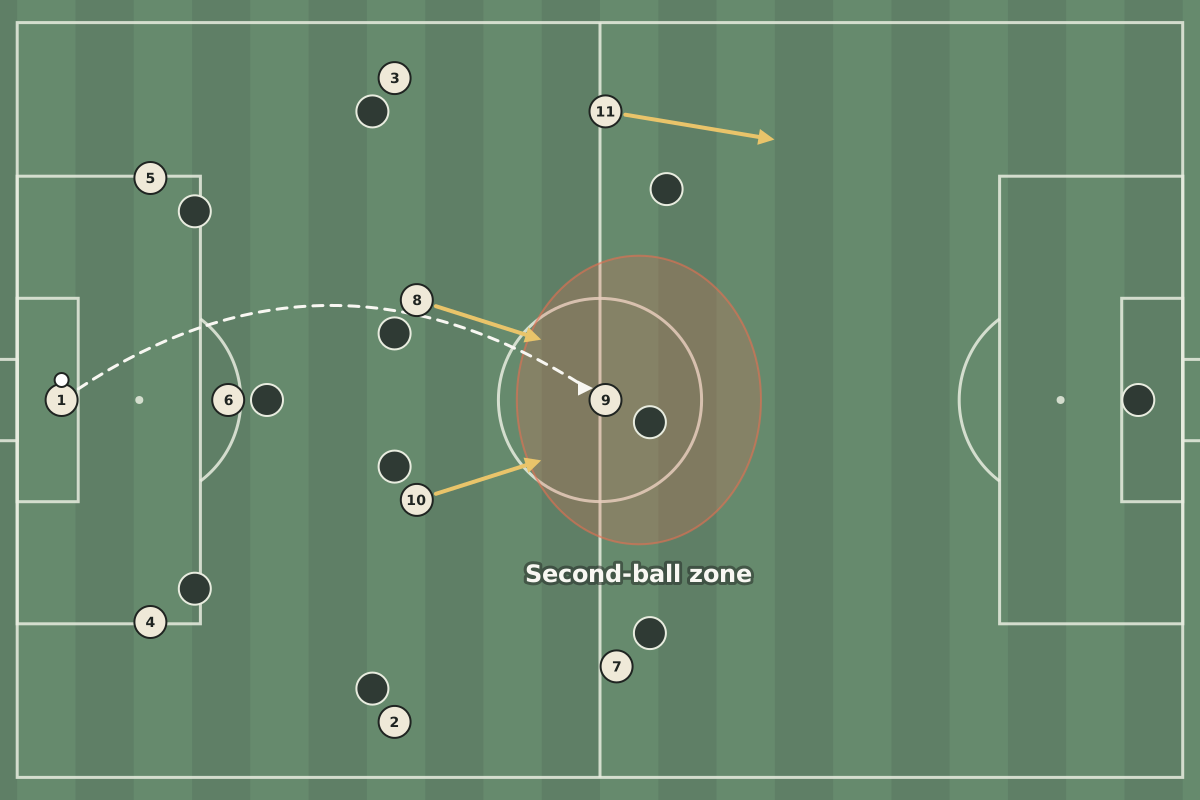
Figure 2: The dark team presses man-for-man. Every short option is marked, so the goalkeeper goes long to the striker (9) and the light midfielders run forward into the shaded second-ball zone.
In Figure 2, every short option is covered. Two dark strikers are on the centre-backs, a third dark player is on the holding midfielder, and the dark wide players are tight to the full-backs. A short pass here is likely to be intercepted near your own goal, which is the worst place on the pitch to lose the ball.
When going long is the smart choice
Now look at the other half of the pitch in Figure 2. Because the dark team has pushed so many players forward, only three defenders are left at the back against three light attackers. There is no spare defender, and there is a lot of space behind the defence.
This is the moment to go long. The goalkeeper’s pass in Figure 2 is aimed at the striker (9), and the yellow arrows show the light midfielders (8 and 10) running forward into the shaded zone. The winger (11) runs in behind, in case the striker can flick the ball on.
If the striker wins the header or holds the ball up, the team is suddenly attacking with numbers. If they lose it, the midfielders are already there to fight for the second ball.
A long ball like this is not a panic clearance. It is a planned pass into a planned area, with players ready to support it. The difference between the two is whether your team knows where the ball is going before it is kicked.
Opinion: I think “always play out from the back” is as unhelpful as “always kick it long”. The teams I enjoy watching most do both, and they choose based on how the opponent is pressing. Building from the back is a tool, not a belief system.
Three questions before every goal kick
I give my players three questions to ask before a goal kick.
First, how many players are pressing? If it is fewer than the number we have near our own goal, play short.
Second, is anyone free? If the opponent has matched us player for player, the free man is probably further up the pitch, so look long.
Third, where is the space? If the opponent’s back line has pushed up towards the halfway line, there is space behind it. That space is often worth more than a short pass that only moves the problem five yards to the side.
Common mistakes I see at grassroots level
The most common mistake is playing short because the coach said so, whatever the situation. Players pass into a crowded area, lose the ball and concede. Then they lose confidence and stop wanting the ball at all.
The second mistake is poor body shape. A centre-back who receives facing their own goal has very few options. I coach defenders to receive half-turned, with their body open to the pitch, so they can see the next pass before the ball arrives.
The third mistake is standing too close together. If the centre-backs split only a few yards apart, one striker can press both of them. The width in Figure 1 is not for show. It is what makes the opponent’s job hard.
A final mistake is forgetting the next step. Getting the ball from the keeper to a centre-back is the easy part. The team also needs a plan for the pass after that, usually into a midfielder or a full-back who can receive facing forward.
Coaching build-up with young players
Opinion: I believe young players should be given the chance to build from the back, even when it costs goals. Learning to pass under pressure is a skill they will need at every level. The result of one under-11s match matters far less than a defender learning to stay calm on the ball.
That said, I always teach the long option at the same time. Players need to know that a long ball can be a good decision, and they need to practise doing it well. A planned long pass, aimed at a teammate with support around them, is a skill in its own right.
In training, I use a simple game where the goalkeeper starts every attack. Two or three pressers try to win the ball, and the building team scores a point by passing into a target player near the halfway line. If the pressers win it, they can shoot straight away.
It is a simple practice, but it puts players in the exact decision they face on a Saturday. I add a fourth presser once the building team is comfortable, so that going long starts to become the right answer.
The short version
Teams build from the back to keep control of the ball and to pull the opposition out of shape. The usual shape has wide centre-backs, a dropping midfielder and a keeper who can pass. When the opponent presses man-for-man, the free space is usually further forward, and a well-planned long ball can be the cleverest pass on the pitch.
Every tactical claim on Pressing Matters is backed by match footage or published data, cited with the match and date. Opinion is labelled as opinion. Spotted a mistake? Tell us and we will correct it at the end of the article.
Written by
Callum Rees
A former youth-team coach from Cardiff with a UEFA B licence, Callum spent eight years running sessions before he started writing about them.
More from Callum Rees