How teams defend corners: zonal, man-to-man and hybrid explained
Zonal, man-to-man or a mix of both? Who stands where at a corner, why the near post matters, and what each system is weak against, from pros to Sunday league.
By Niamh Doherty 9 min read
Key facts
- Topic
- Set pieces
- Written by
- Niamh Doherty
- Published
- Reading time
- 9 minutes
In short
- Zonal defenders guard space; man-to-man defenders guard people. Most teams now use a mix of the two.
- The near-post zone is the first thing most corner routines attack, so it is usually the first space a defence fills.
- Zonal systems are weak against attackers who arrive at pace; man-to-man systems are weak against blocks and screens.
- At grassroots level, the simplest system your players can repeat every week usually beats the cleverest one.
A corner is the one moment in open play where every player has time to get set. That makes it the purest test of how a team has been organised, and it is why I spend so much of my weekend data work looking at them. In this guide I will walk through the three main ways of defending a corner, who stands where, and what each one is weak against.
Why corners are worth the effort
Corners matter because they are repeatable. A team might win several in a match, and every one of them is a chance for the opponent to run a routine they have practised all week. A goal from open play needs a lot of things to go right at once; a goal from a corner often needs one good delivery and one lost header.
The laws also shape the problem. Defenders have to stand at least 9.15 metres from the corner arc until the ball is kicked, and offside does not apply to a player receiving the ball directly from a corner. That means attackers can stand anywhere, including right on top of the goalkeeper, and the defence cannot push up to catch them out.
So every corner system is really an answer to one question. Do you defend the space where the ball is likely to land, or do you defend the people who are trying to get there?
Zonal marking: defending space
In a zonal system, each defender is given an area of the box rather than an opponent. Their job is to attack the ball if it comes into their zone, whoever is running at it. They do not follow runners around the box.
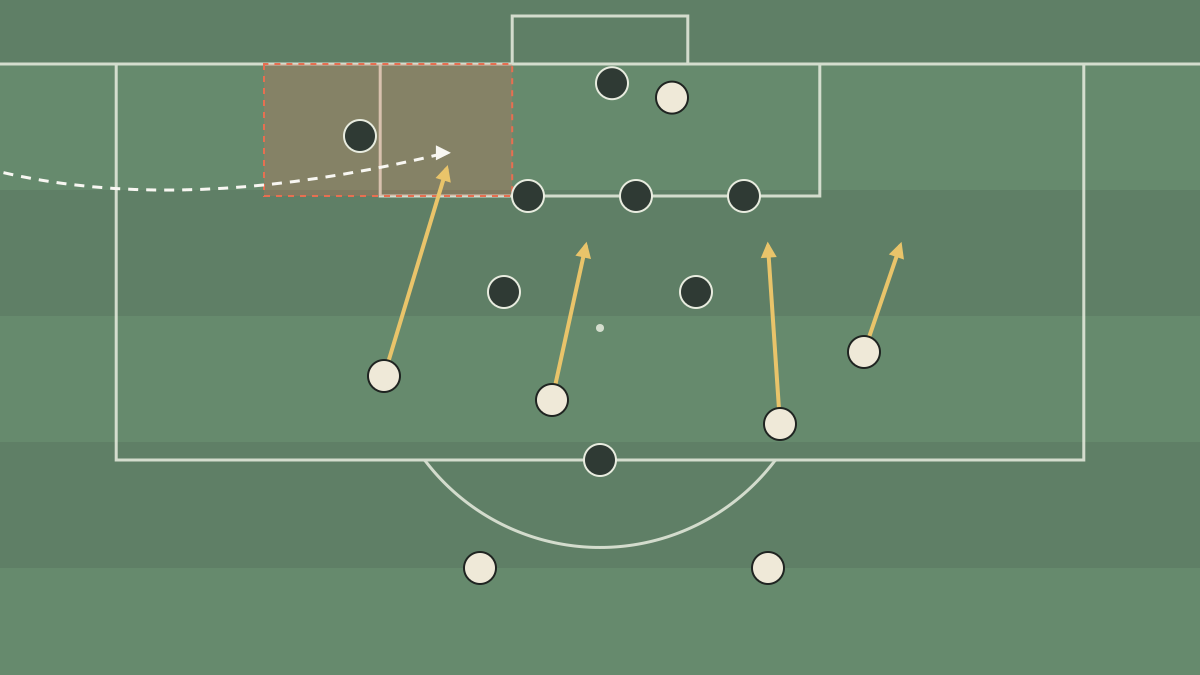
In Figure 1, you can see a typical zonal set-up against an inswinging corner from the left. The goalkeeper stays on the goal line. Defender 1 stands in the near-post zone, the shaded box in front of the near post. Defenders 2, 3 and 4 stand in a line along the edge of the six-yard box, a few yards apart, covering the area where most deliveries are aimed.
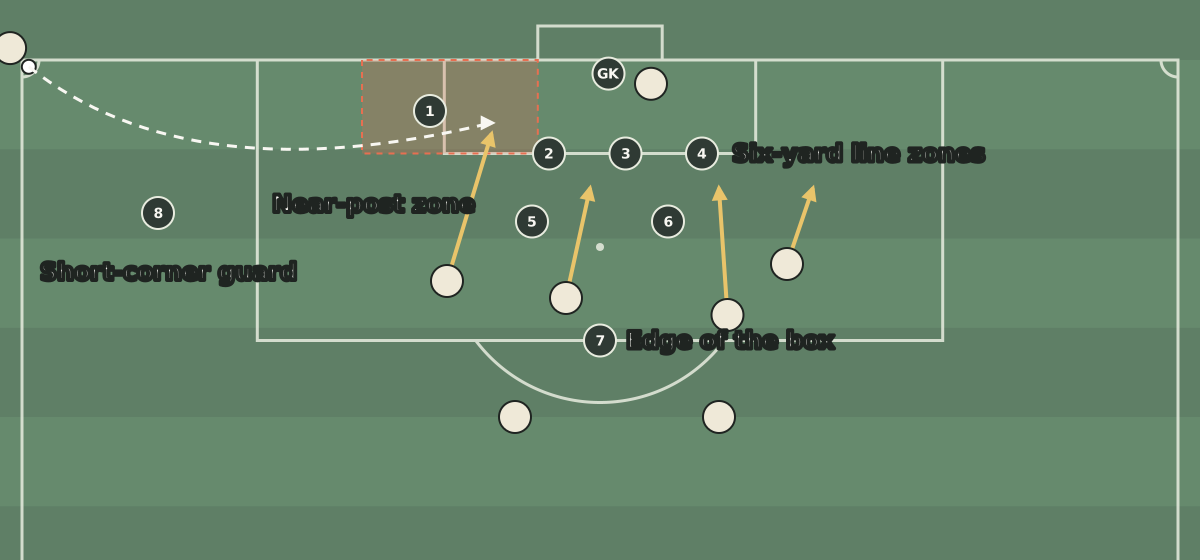
Figure 1: Zonal marking. Defenders 1 to 4 hold the near post and the six-yard line, 5 and 6 sit in a second line, 7 guards the edge of the box and 8 stops a short corner. The light-shirted attackers run into the gaps.
Behind that first line, defenders 5 and 6 form a second line around the penalty spot. They deal with balls that clear the first line and with any knock-downs. Defender 7 stands on the edge of the box to pick up clearances and loose shots, and defender 8 stays close to the corner taker to discourage a short corner.
The great strength of zonal marking is that the defender is already standing still, facing the ball, when it arrives. A defender attacking a ball from a standing start, watching it the whole way, usually wins it against an attacker who has had to run and look over their shoulder at the same time.
The near-post zone
The near-post zone deserves its own section. It is the first space the ball travels through on most deliveries, and it is the space most routines target first. If an attacker gets a touch there, even a glancing one, the ball can be flicked across goal or into the far corner before the goalkeeper has time to move.
That is why, in Figure 1, defender 1 is placed in front of the near post rather than on it. I would rather a defender meet the ball early, on the front of the zone, than wait on the line and hope it comes straight at them.
What zonal is weak against
The main weakness of zonal marking is pace. An attacker who starts deep and runs at full speed into a zone will often jump higher than a defender who has been standing still. You can see that in Figure 1: four attackers make arrowed runs into the spaces between and in front of the zonal defenders.
The second weakness is the seams between zones. If the ball lands exactly between defenders 2 and 3, both may hesitate, each thinking the other will go. Good attacking teams aim their deliveries at those seams on purpose.
Man-to-man marking: defending people
In a pure man-to-man system, each outfield defender is given one opponent to follow. Wherever that attacker goes, the defender goes too. The aim is to stop the attacker getting a clean jump, even if the defender does not win the header themselves.
The strength here is accountability. If a goal is conceded, it is usually clear who lost their runner. It also deals well with fast runs, because the defender is moving with the attacker rather than waiting for them.
The weakness is that man-to-man defending turns every corner into a series of races. Defenders have to start goal-side and stay there while attackers twist, stop and change direction. That is tiring, and it is easy to lose a runner for half a second, which is all a good header needs.
Blocks and screens
The biggest problem for man-to-man marking is the block, sometimes called a screen. An attacker who has no intention of heading the ball stands in the path of a defender, so that the defender’s runner can get free. In my experience, a well-placed block is very hard to get around, and it is hard for a referee to penalise when nobody uses their arms.
You will see this in Figure 2. Defender 5 is trying to follow their runner, but a second attacker has stepped into their path. The red bar marks the block. By the time defender 5 has gone round it, the runner is already curving towards the back of the six-yard box.
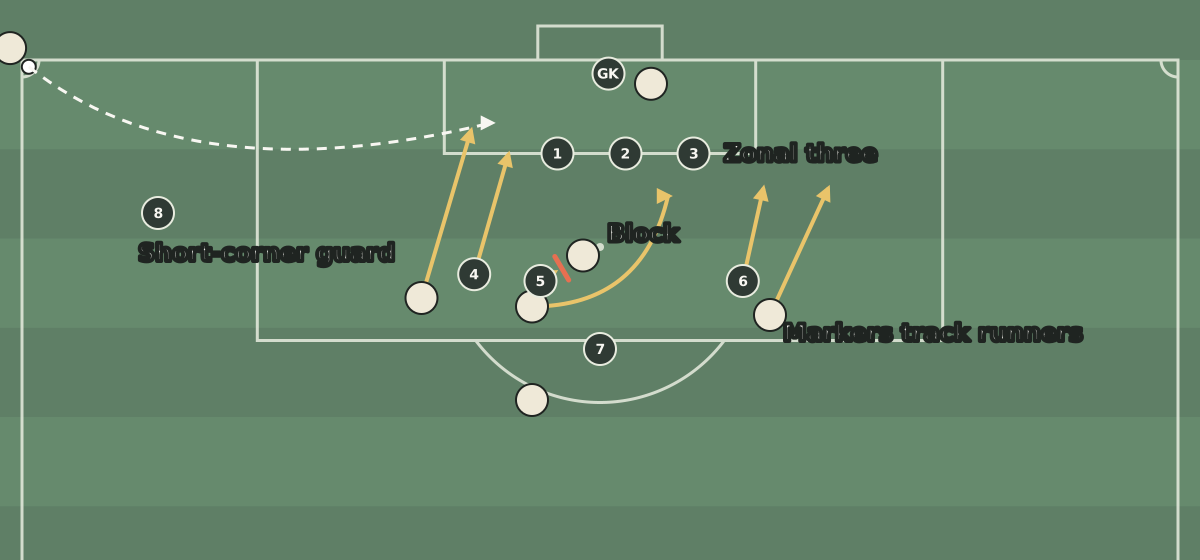
Figure 2: A hybrid system. Defenders 1, 2 and 3 hold zones on the six-yard line while 4, 5 and 6 follow runners. Notice how defender 5 is blocked, and how the zonal three are still there to meet the ball.
Hybrid systems: the best of both
Most teams I watch now use some kind of hybrid. A small group of players defends zones, usually along the six-yard line and at the near post, while the rest mark the most dangerous attackers. The idea is that the zonal players protect the most important space, and the markers stop the best headers getting a run at it.
Figure 2 shows one common version. Defenders 1, 2 and 3 form a zonal line across the six-yard box. Defenders 4, 5 and 6 start goal-side of their runners and follow them. Defender 7 guards the edge of the box and 8 guards against the short corner.
The hybrid answers the main weakness of each pure system. If a marker is blocked, as defender 5 is in Figure 2, the runner still has to beat a zonal defender who is standing in the space they are running into. If an attacker arrives at pace, they still have a marker on their shoulder making the jump harder.
The cost is complexity. Each player needs to know whether they are a zone or a marker, and who they swap with if the opposition change their set-up.
Opinion: I think the hybrid is the most sensible default for most teams, because it fails more gracefully than either pure system. When one part breaks, another part is usually still standing.
Other jobs at a corner
Beyond the main system, a few jobs come up again and again.
The short-corner guard, defender 8 in both figures, stops the attacking team simply passing the ball short and creating a two-against-one near the corner flag. Without that player, a defence can be pulled apart before the ball ever reaches the box.
The edge-of-the-box player, defender 7, deals with cleared balls that drop around the D. If that space is empty, a cleared header can come straight back as a shot, often through a crowd that blocks the goalkeeper’s view.
Players on the posts are a matter of taste. Some teams put a defender on one or both posts to clear shots off the line. Others feel that a player on the post is a wasted body who also plays attackers onside once the ball goes back out. In both figures I have left the posts empty, which is increasingly common.
How to read corners when you watch a match
When I watch a corner, I try to look away from the ball for the first few seconds. I count how many defenders are standing still and how many are moving with a runner. That usually tells me straight away whether the system is zonal, man-to-man or a hybrid.
Next, I look at the near post. Who is there, and are they standing in front of the post or on it? Then I watch where the attackers start. If they all begin in a cluster near the penalty spot, they are probably planning to split up late and run at the seams.
Finally, I watch the second ball. A lot of goals from corners come not from the first header but from what happens after it. A team that clears the first ball but has nobody on the edge of the box is only half organised.
Choosing a system at grassroots level
At grassroots level, the choice looks different. Players are not all the same height, sessions are short, and the line-up can change every week. A system that needs eleven players to understand their exact role will not survive a Sunday when three regulars are missing.
My advice would be to start with a simple zonal core. Put your two or three best headers of the ball in a line across the six-yard box, and one brave player in front of the near post. These are positions players can learn by standing in them, and they do not change whoever the opposition are.
Then add markers only for the opposition’s biggest threats. If they have one tall centre-back who comes up for every corner, give one of your players the job of following that player and nobody else. That turns a zonal system into a light hybrid without making it complicated.
Opinion: At grassroots level, I would pick the system your team can repeat without thinking over the one that looks best on a whiteboard. A slightly worse plan that everybody follows will concede fewer goals than a clever plan that half the team forgets.
Coaching points to take away
Whatever system you choose, a few principles apply across all of them.
- Attack the ball. A defender who meets the ball at the highest point wins far more than one who waits for it to drop.
- Start goal-side. Markers should always begin between their runner and the goal.
- Talk early. The goalkeeper should call for the ball, or call a name, before it arrives.
- Win the second ball. Clearing the first header is only half the job; the edge of the box must be covered.
Corners will always feel like a lottery from the stands. In my experience, though, the teams that concede the fewest are rarely the luckiest. They are the ones where every player knows exactly where to stand, and why.
Every tactical claim on Pressing Matters is backed by match footage or published data, cited with the match and date. Opinion is labelled as opinion. Spotted a mistake? Tell us and we will correct it at the end of the article.
Written by
Niamh Doherty
A Belfast data analyst who builds her own expected-goals models at weekends and checks every number twice.
More from Niamh Doherty