Explainer Fantasy & Betting
Football odds explained: what the numbers really mean
Fractional and decimal odds are just probabilities in disguise. Here is how to read them, convert them and spot the bookmaker's built-in margin.
Odds guide · 3 min read
Key points
- Fractional and decimal odds describe the same thing in different ways.
- Every price can be turned into an implied probability.
- Add up a market's implied probabilities and you find the bookmaker's margin.
- Betting is entertainment with a cost, not a way to make money.
This is an explainer, not a tipping column. Nothing here is a recommendation to bet on any match. It is about understanding what odds mean.
Football odds look like a code, but they are simply a way of expressing how likely an outcome is, plus the return on offer. Once you can read them, you can see exactly what a price is saying.
Fractional odds
Fractional odds are the traditional British format. They show how much you win relative to your stake.
- 2/1 (“two to one”) means you win 2 for every 1 you stake, and get your stake back as well.
- 1/2 (“two to one on” or “one to two”) means you win 1 for every 2 staked. The outcome is seen as more likely than not.
- Evens, or 1/1, means you win the same amount you staked.
The number on the left is the potential profit. The number on the right is the stake that earns it.
Decimal odds
Decimal odds are common across Europe and on many betting apps. They show the total return for every 1 staked, including the stake.
Converting is simple: add 1 to the fraction.
- 2/1 becomes 3.00
- 1/2 becomes 1.50
- Evens becomes 2.00
So a 10 stake at 3.00 returns 30 in total if it wins, which is 20 profit plus the original 10. That is exactly the same as 2/1.
Turning odds into probability
Every price has an implied probability. This is the chance of the outcome that the odds suggest.
With decimal odds, divide 1 by the price. These are illustrative examples using round numbers:
- Example: 2.00 (evens). 1 divided by 2.00 is 0.50, or a 50% implied chance.
- Example: 3.00 (2/1). 1 divided by 3.00 is about 0.333, or roughly 33%.
- Example: 1.50 (1/2). 1 divided by 1.50 is about 0.667, or roughly 67%.
- Example: 5.00 (4/1). 1 divided by 5.00 is 0.20, or 20%.
With fractional odds, divide the right-hand number by the sum of both numbers. For 4/1, that is 1 divided by 5, which again gives 20%.
Implied probability is the bookmaker’s view of the price, not a fact about the match. Nobody knows the true chance of a football result.
The bookmaker’s margin
Here is the part many casual punters never notice. Add up the implied probabilities across a whole market and the total comes to more than 100%.
That extra is the overround, or the bookmaker’s margin. It is how the bookmaker builds in an edge.
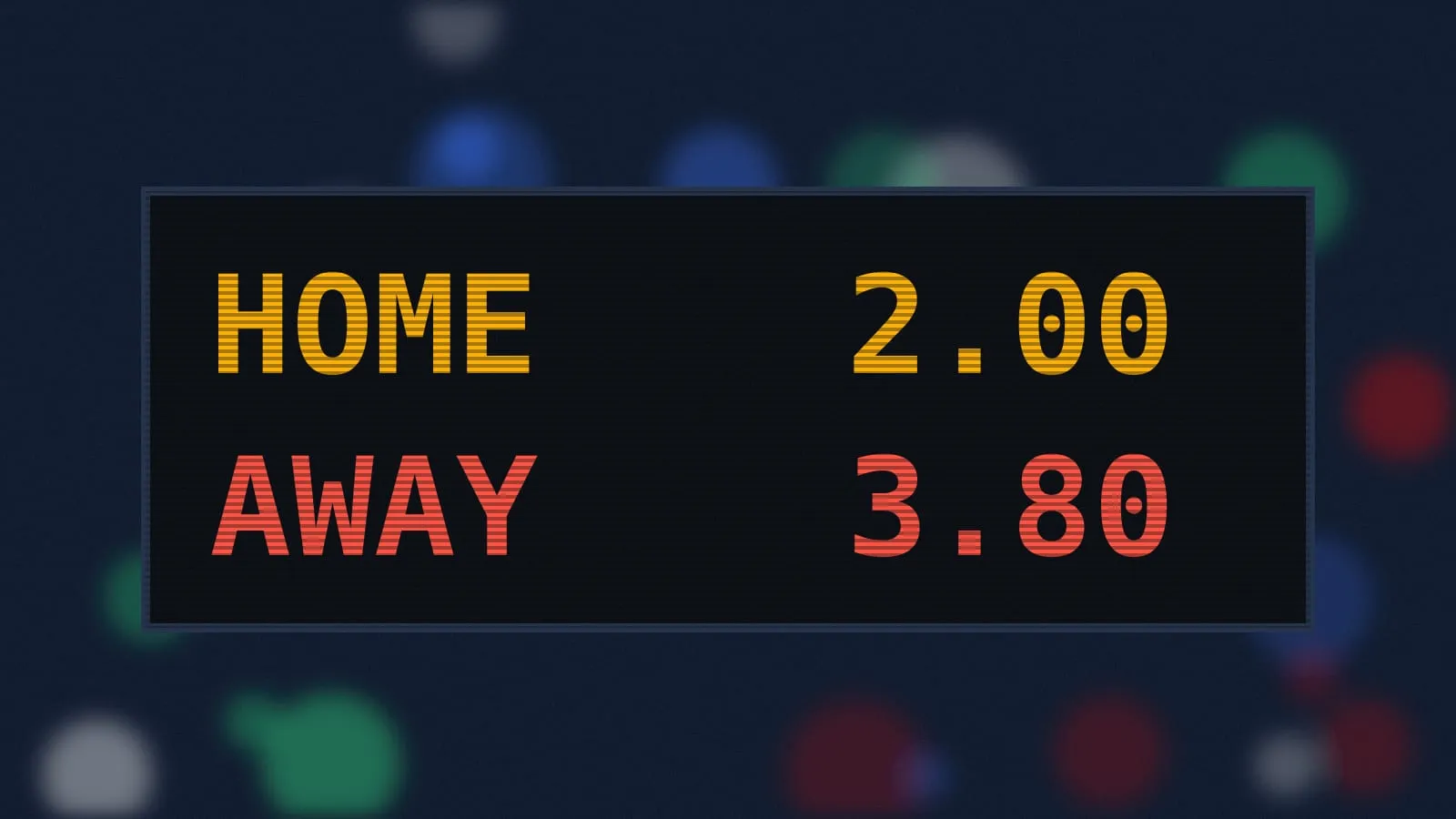
Take an illustrative match result market, often called 1X2 (home win, draw, away win). These are example prices only:
- Home win at 2.00: implied 50.0%
- Draw at 3.40: implied about 29.4%
- Away win at 3.80: implied about 26.3%
Added together, that is roughly 105.7%. In a perfectly fair book, the three outcomes would add up to exactly 100%, because one of them must happen.
The extra 5.7 percentage points in this example is the margin. It means the prices on offer are slightly shorter than a fair price would be across the board.
Margins vary between markets and operators. Markets with many possible outcomes, such as correct score or first goalscorer, often carry bigger margins than a simple match result.
Why “value” does not mean income
You will hear a lot of talk about “value”, meaning a price that looks bigger than the true chance of the outcome.
It is opinion, not certainty. Nobody can measure the true probability of a football match, so judging value is always a guess.
Because of the margin, the maths of betting generally favours the bookmaker over time. Betting should be treated as paid entertainment, like a cinema ticket, not as a way to earn money or recover losses.
Safer gambling tools
Licensed operators in Britain must offer tools to help customers stay in control. They are worth setting up before you place any bet, not after things go wrong.
- Deposit limits cap how much you can put into your account over a day, week or month.
- Time-outs let you take a short break from your account.
- Reality checks remind you how long you have been playing.
- Self-exclusion blocks you from an operator for a longer period. There is also a national scheme that lets you exclude yourself from all licensed online operators in Britain at once.
These tools are found in your account settings. The Gambling Commission, which regulates gambling in Britain, sets the rules operators must follow.
The bottom line
Odds are a language, and it is a simple one once you know it. Read the price, convert it to a probability, and remember the margin built into every market.
Then decide what you are happy to spend on entertainment, set your limits, and stick to them.
Odds at a glance
- Fractional
- 2/1 means win 2 for every 1 staked
- Decimal
- Fractional plus 1, so 2/1 is 3.00
- Evens
- 1/1 or 2.00, an implied 50%
- Implied probability
- 1 divided by the decimal odds
- Overround
- Total implied probability above 100%
What it means for fans
Understanding odds helps you see what a price is really saying and how the bookmaker builds in its margin. It does not turn betting into income, so set limits before you start.
Ravi Chandran · Fantasy and betting writer
A Leicester-born fantasy football obsessive who has finished in the top 5,000 three seasons running and writes the weekly picks column.
Our news is checked against club statements and official sources before it is published. Rumours are labelled with their source. Fantasy and betting pieces are opinion, not tips. Spotted an error? Tell the desk.